


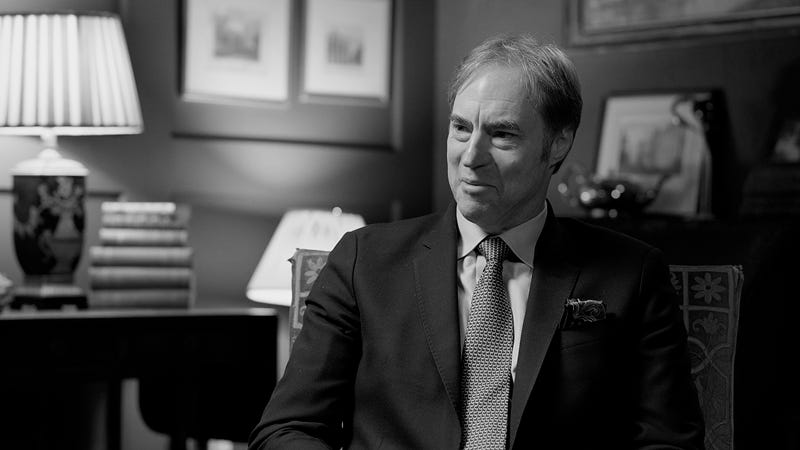
Few thinkers have done more to reopen the question of God in modern science than Stephen Meyer. A former geophysicist who later trained in the philosophy of science at Cambridge, Meyer has spent decades examining one of the deepest puzzles in biology: the origin of the information encoded in DNA. His work argues that the discovery of complex, specified information at the heart of life raises profound questions that purely material explanations struggle to answer.
As a leading figure in the intelligent design movement and a longtime director at the Discovery Institute, Meyer has helped bring debates about science, metaphysics, and theism back into the public square. His bestselling books, including Signature in the Cell, Darwin’s Doubt, and The Return of the God Hypothesis, explore how developments in cosmology, physics, and molecular biology may point beyond a purely material understanding of reality.
In recent years, Meyer’s work has reached a wider audience through major media appearances and long-form conversations, reflecting a growing cultural interest in questions about meaning, origins, and the limits of scientific materialism.
Why did we invite him on?
The modern world often assumes that science has settled the question of God. Meyer challenges that assumption directly.
At a time when the relationship between science and faith is often framed as a conflict, Meyer represents a different approach. He argues that some of the most important discoveries in modern science, from the Big Bang to the informational structure of life, are reopening philosophical and theological questions that many thought had been closed.
We wanted to explore whether the latest discoveries in cosmology and biology truly support a materialist worldview, or whether they instead point toward a deeper metaphysical explanation of reality.
What did we talk about?
Our conversation begins with Meyer’s intellectual journey. Originally trained as a geophysicist, he became fascinated by the question of how life first emerged on Earth. What he discovered was that explaining the origin of life ultimately requires explaining the origin of biological information. The digital code embedded in DNA, which directs the construction of the cell’s molecular machinery, poses a profound scientific and philosophical challenge.
From there, we explore one of Meyer’s central claims: that information in nature may be evidence of mind. Drawing on developments in information theory and molecular biology, he argues that the informational structure of life resembles the kinds of systems we normally associate with intelligent agency.
The discussion then broadens to the wider scientific picture. Meyer outlines three major discoveries that he believes have reshaped the debate about God in modern science: the beginning of the universe implied by Big Bang cosmology, the fine-tuning of the physical constants that make life possible, and the discovery of complex information within living cells. Taken together, he argues, these discoveries have revived the possibility of a theistic understanding of the cosmos.
We also examine the controversy surrounding intelligent design. Meyer recounts how debates that began as technical discussions in philosophy of science unexpectedly erupted into major public disputes in the early 2000s, placing questions about evolution, design, and scientific orthodoxy at the centre of cultural conflict.
Finally, we turn to the deeper philosophical issues behind the debate. What is information? Can it be reduced to matter and physics, or does it point to something beyond them? And what might these questions reveal about the relationship between science, metaphysics, and theology today?
A superb conversation which I highly recommend. Anyone who assumes that science has buried God really needs to think again. The opposite is looking a lot more like the rational position.
Thank you. His book The Return of the God Hypothesis articulated by unformed belief in Intelligent Design, formed by the extraordinary beauty of nature and the Universe.